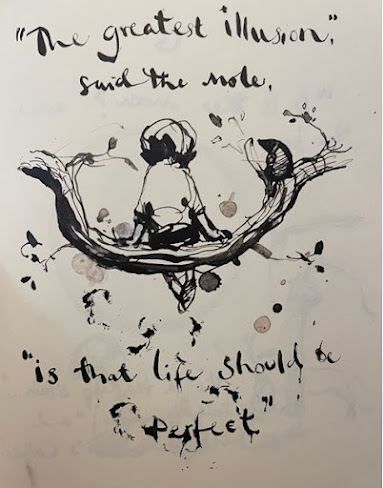
The greatest menace to progress is not ignorance, but the illusion of knowledge.
-Daniel Boorstin, Cleopatra's Nose
The greatest menace to progress is not ignorance, but the illusion of knowledge.
-Daniel Boorstin, Cleopatra's Nose
The guiding notion of the Enlightenment, and later of Marx and Lenin's "scientific" socialism, was that henceforth the alliance between happiness and justice would no longer come about through the individual quest for wisdom, but through the rebuilding of society as a whole. And before building a new society, the old one first had to be completely destroyed. It was at the end of the eighteenth century that the idea of revolution took on its modern meaning. Personal salvation was from then on subordinate to collective salvation. . . . suffice it to say that somewhere between 1965 and 1970 I thought I'd seen the irremediable bankruptcy of this illusion, the progenitor of the great totalitarian movements that have ravaged the twentieth century.
Only six people in the Galaxy knew that the job of the Galactic President was not to wield power but to attract attention away from it.
- Douglas Adams, via Chris Lynch
Truth isn’t the sum of many facts: It works the other way around. We erect frameworks of understanding which the facts must fit into or modify. A healthy society will debate the relationship between a given fact and its role in our understanding of the world. The catastrophic failure of the mediators means that we now debate the frameworks and their meanings among ourselves. In this rolling chaos, interpretations have turned tendentious and partial. Reality has splintered into a million pieces. That’s the post-truth condition. . . .
The 20th century’s illusion of narrative integrity is gone forever. We now stumble along in the dark, plagued by uncertainty—an accurate description, I note, of the human condition.
-Martin Gurri, from this essay
Religion begins by offering magical aid to harassed and bewildered men; it culminates by giving to a people that unity of morals and belief which seems so favorable to statesmanship and art; it ends by fighting suicidally in the lost cause of the past. . . . Institutions which were at first in the hands of the clergy, like law and punishment, education and morals, marriage and divorce, tend to escape from ecclesiastical control, and become secular, perhaps profane. The intellectual classes abandon the ancient theology and - after some hesitation - the moral code allied with it; literature and philosophy become anticlerical. The movement of liberation rises to an exuberant worship of reason, and falls to a paralyzing disillusionment with every dogma and every idea.
-Will and Ariel Durant, The Story of Civilization: The Renaissance
In the realm of tradition, truth is something that precedes individual human beings, something we inherit and must hand down, in turn. We can discover truth and reason about it, to be sure, but we can't change it. In the realm of progress, however, truth is what individuals or groups can articulate or build on their own, through scientific inquiry and their acts in history. Truth thus becomes an ongoing project, a malleable thing. In our realm of progress, tradition is viewed as not only antiquated and inefficient, but as an impediment to achievement.
But what if that confidence of the modern world is an illusion, the product of a determined resolution not to confront the fundamental dilemmas of what it means to be fully human? Or what if beneath the moderns' complacency lurks a deep soul-soreness?
Pick your favorite negatively trending social indicator—loneliness, alienation, addiction, polarization, etc.—and the dire message is the same: the realm of progress can't fulfill our soul's yearning or satisfy our urge to put ourselves right with the sacred.
-Sohrab Ahmari, The Unbroken Thread: Discovering the Wisdom of Tradition in an Age of Chaos
It’s not just the serial overreactions, the threatening intensity, the constant reference to dramatically worse events supposedly yet to come. It’s the feeling of mandatory panic, the insistence that anyone who does not allow the crisis to dominate their internal life is somehow guilty of causing it, the desire to blame a disaster on people who are thought to not take it seriously enough.
-Freddie de Boer, as extracted from here
Fortunately, some are born with spiritual immune systems that sooner or later give rejection to the illusory worldview grafted upon them from birth through social conditioning. They begin sensing that something is amiss, and start looking for answers. Inner knowledge and anomalous outer experiences show them a side of reality others are oblivious to, and so begins their journey of awakening. Each step of the journey is made by following the heart instead of following the crowd and by choosing knowledge over the veils of ignorance.


 Posts
All Comments