Showing posts with label Fixing Things. Show all posts

Monday, March 16, 2026

Hard lessons................


      Hippies were so dedicated to living in the moment that preventive maintenance was a difficult lesson for us.  Something breaking was a big event.  Repairing the broken thing is a big event.  But preventing the thing from breaking is a non-event.  Doing a responsible task like changing the oil doesn't come naturally.  It's a messy chore, tedious and thankless.  There's no reward when you do it and no reward later—just the unnoticeable absence of pain.

     To acquire the adult discipline of preventive maintenance, us flower children had to learn at soul depth the remorseless logic of "An ounce of prevention is worth a pound of cure." . . .

     Once the pain of avoidable repair is severe and repeated a few times, the attraction of heading off the pain with preventive maintenance becomes compelling.  Then all we need is knowledge of what to do and when and how to do it.

     The universal advice from professional maintainers to every impatient equipment misuser is an expletive: "Read the fucking manual!"  By which they mean: Part of taking proper ownership of something is to study the manual first.

-Steward Brand, Maintenance: Of Everything


Sunday, March 15, 2026

Old school.....................


The American university is broken. The people running the universities know it, which is why they have redoubled their efforts to make sure you can’t do anything about it.

-Colin Redemer, from this essay

via


Thursday, January 29, 2026

Are these numbers correct.......?


     Compare this with a closed system, such as healthcare and hospitals.  That industry takes a very different approach to dealing with errors; not surprisingly, it produces vastly inferior results.

     How different?  Syed notes the remarkable contrast between air travel and preventable medical errors:  After heart disease and cancer, medical errors are the third leading cause of death in America.  As many as a half-million fatalities in the US, at a cost estimated at $17 billion a year, are due to errors.  Peter Pronovost, a clinician at Johns Hopkins Medical School, wondered how we would respond if two 747 jumbo jets fell out of the sky each day, killing roughly 900 people.  That's how many people die daily from medical mistakes.

     Why is health care so different from aviation?  First, there is little publicly available data and no standardized review process when errors occur.  Whatever self-evaluation takes place is private, sealed, and not readily available for public scrutiny.  Some people believe doctors are infallible saviors, creating a reluctance to admit error.  Insurance costs, litigation, and protecting reputations reduce the industry's desire for public accounting.  In short, healthcare is everything that aviation is not.

-Barry Ritholtz,  How Not To Invest: The Ideas, Numbers, and Behaviors That Destroy Wealth—And How To Avoid Them


Sunday, November 2, 2025

Ownership......................


Does the world happen to you, or do you happen to the world?

Most people wait for permission to solve problems. The subtle message they send is “I don’t care enough to solve this on my own. Tell me what to do.” The world happens to them.

High agency people are different. They care. And because they care, they solve problems without being told. They happen to the world.

High agency people act like owners. Owners see a problem and fix it. They don’t wait. They don’t need permission. They don’t think this is someone else’s job. They don’t think this is hard. They don’t think “I can’t do this, I’ve never done it before.” They don’t think this is someone else’s job.

Act like an owner before you are one. That’s how you become one.


-Shane Parrish, from the November 2 edition


Friday, August 1, 2025

Got to work on this one recently............


Take great care to avoid mistakes when the decision is hard to reverse.

But! If you make a mistake that is hard to reverse, there is no sense beating yourself up about it. Your responsibility is to make the best next choice given your current position. You must always make the most of the situation you are in.

Next play mentality.

-James Clear, from this episode


Thursday, November 16, 2023

advantage........................

All the time and energy you spend fixing your unforced errors comes at the expense of moving toward the outcomes you want.  There is a huge advantage in having more of your energy instead go toward achieving your goals instead of fixing your problems.

-Shane Parrish, Clear Thinking: Turning Ordinary Moments into Extraordinary Results 

Monday, October 2, 2023

A remodeling project is on-going..................

 ...........................at Sippican Cottage:

So, we were presented with a common design dilemma. A Victorian house is laid out differently than a more recent pile of sticks and bricks. The rooms are too big, or too small, or not where you expect them. Bathrooms are always in short supply, although a Victorian bathroom in good repair is a wonderful thing. They invented bathrooms, after all. They pretty much got it right on the first go-round. Everything was white, for cleanliness. Toilet, sink, tub, lots of white tile, with interesting patterns on the mosaic floors.

A Victorian house with two bathrooms was a rarity. For instance there used to be a pecking order of poshness for Boston Irish, which I am, sorta.  They knew a thing or two about Victorian houses, and pecking orders. They had to mop the floors in them at first, and eventually they lived in them when the structures were run down enough to afford the rent. The bottom rung of the Boston Irish social climbing ladder was ignant bogtrotter. Then came shanty Irish. If you rose further in the world, you could become cut-glass Irish, also known as lace-curtain Irish. Middle class. The pinnacle, of course, was two-toilet Irish.

Thursday, March 30, 2023

Mistakes.......................

I don't want you to think we have any way of learning or behaving so you won't make a lot of mistakes.  I'm just saying that you can learn to make fewer mistakes than other people—and how to fix your mistakes faster when you do make them.  But there's no way that you can live an adequate life without making many mistakes.  In fact, one trick is to get so you can handle mistakes.  Failure to handle psychological denial is a common way for people to go broke.

-Charlie Munger

Sunday, May 16, 2021

the adoption of responsibility...........................

      If you want to become invaluable in the workplace—in any community—just do the useful things no one else is doing. . . .

      You might object, "Well, I could not manage to take on something that important."  What if you began to build yourself into a person who could?  You could start by trying to solve a small problem—something that is bothering you, that you think you could fix.  You could start by confronting the dragon of just the size that you are likely to defeat.  A tiny serpent might not have had the time to hoard a lot of gold, but there might still be some treasure to be won, along with a reasonable probability of succeeding in such a quest (and not too much chance of a fiery or toothsome death).  Under reasonable circumstances, picking up the excess responsibility is an opportunity to become truly invaluable.  An then, if you want to negotiate for a raise, or more autonomy—or more free time, for that matter—you can go to your boss and say, "Here are ten things that were crying out to be done, each of them vital, and I am now doing all of them.  If you help me out a bit, I will continue.  I might even improve.  And everything, including your life, will improve along with me."  And then, if your boss has any sense—and sometimes bosses do—then your negotiation will be successful.  This is how such things work.  And do not forget that there is no shortage of genuinely good people who are thrilled if they can give someone useful and trustworthy a hand up.  It is one of the truly altruistic pleasures of life, and its depth is not to be underestimated, or to be disregarded with cheap cynicism that masks itself as world weary wisdom.

    It appears that the meaning that most effectively sustains life is to be found in the adoption of responsibility.

-Jordan Peterson, Beyond Order:  12 More Rules For Life

Friday, May 10, 2019

From her lips to God's ears......................


      Your brain's health may be the most powerful indicator of how long you will live.  It is crucial to whether that life will be rich and satisfying from youth into old age, or something substantially less rewarding, and for less time.
      A car driven wisely, fueled with high-quality gasoline, given regular oil changes, and repaired with new parts as old ones wear out is likely to last longer than one that's abused or neglected.  Likewise, the easiest way to have a healthy brain in middle age and beyond is to start with one as a youth and to follow good physical and mental habits.  Exercise it.  Feed it.  Challenge it.  Then enjoy the rewards.
      But what of the person who comes late to the repairs, like the owner of a car that rusts for years on blocks or runs too long on dirty oil?   The car owner can always swap out the engine.  You, on the other hand, have only one brain, basically composed of the same neurons you were born with, plus a few added to some narrowly specific areas.  Once they've begun to deteriorate, can they be saved—or even made stronger?
      Brain researcher Marian Diamond is certain they can.

-Michael S. Sweeney,  Your Best Brain Ever:  A Complete Guide & Workout

Monday, April 29, 2019

Monday, February 18, 2019

The antifragility of capitalism..............


We come here to the great paradox and tentative explanation about why the networked public, so destructive of the status quo, has tolerated and to some extent embraced the standing economic system. . . .  In the current environment, as I understand it, businesses have proved no wiser, more far-seeing, or successful than other institutional actors.  But capitalism, as a whole, has made more productive use of the failure of its parts than most institutions under assault by the public.  To borrow Taleb's terminology, capitalism appears to be "antifragile": it "regenerates itself continuously by using, rather than suffering from, random events, unpredictable shocks, stressors, and volatility."  This has allowed the system to prosper despite the horrors of 2008, while, not unrelatedly, bestowing on the consumer a multitude of new technologies and products.

-Martin Gurri,  Revolt of the Public

Saturday, February 2, 2019

The source...........................


"The source of everything respectable in man either as an intellectual or as a moral being is that his errors are corrigible . . . The whole strength and value of human judgment, depends on the one property, that it can be set right when it is wrong.

-John Stuart Mill

via via

Saturday, September 8, 2018

Reasons I like living in Newark and Licking County..........................


Reason 47A:   The renovation and re-dedication of the "anti-flooding" totem pole.

      The back story is here.   Anyway, the totem pole has been MIA for the past several years.  The wood totem pole was originally erected in 1962.   Did you know that the average life span of a wood totem pole is about seventy years?   After that,  Mother Nature has her way.  Rather than wait until it was too late to save the totem pole, some bright and caring folks (thank you, Dave Fryman!) decided to repair and rehabilitate it.   It has spent the last two years first thoroughly drying out and then being brought back to its original glory.   Today was the unveiling and re-dedication ceremony.   Very timely since our county is receiving 3-6 inches of rain this weekend.  More than 100 folks braved the rain to watch and listen.  Lots of smiles.


Thursday, July 5, 2018

The chimney............................

 
     In the old days, the Old School was heated by a coal-fired boiler.  Part of that heating system was a 70' + high chimney (pictured below).    Coal eventually gave way to natural gas.   The first winter we owned the building we shut the boiler down.   When the gas meter spins fast enough to be audible, you know you need a bigger check book than we had available.  We knew that the conversion to apartment units would require air conditioning, which the Old School did not have, so the boiler system would have to be replaced anyway.   So, the chimney sat idle for the past six years.   While overall the brick work is in pretty good shape, there was a corner near the top of the chimney that had deteriorated and some bricks had fallen out.  We proposed to the historical folks that, rather than repair that brick, we lower the chimney about 30'.   They said, "nope."   Fix it we did.

The tall brick thing is the chimney in question


If you squint your eyes you can see the missing brick near the upper corner


Missing bricks replaced.   The remaining bricks are more solid than they look.

Once washed down, the replacement brick will hardly be noticeable.


So, while repairing the chimney, the question was asked, "what happens to the rain water that falls into the unused chimney?  And should we do something about it now, while we have a super tall lift on site?"   Hmm.   Let's cap it.

While the chimney cap is in surprisingly good condition, the decision was
made to put a sheet metal cap over it.

Suspecting the original architect called for lightning rods at each of the
corners of the chimney cap

Super high lift in action.  Sheet metal for cap is visible
on the left side of the lift

The answer is yes, I put on the appropriate harness and
rode up to the top of the chimney.   Pretty good views of
Newark from up there.

Wednesday, April 4, 2018

Undergrounds...........................


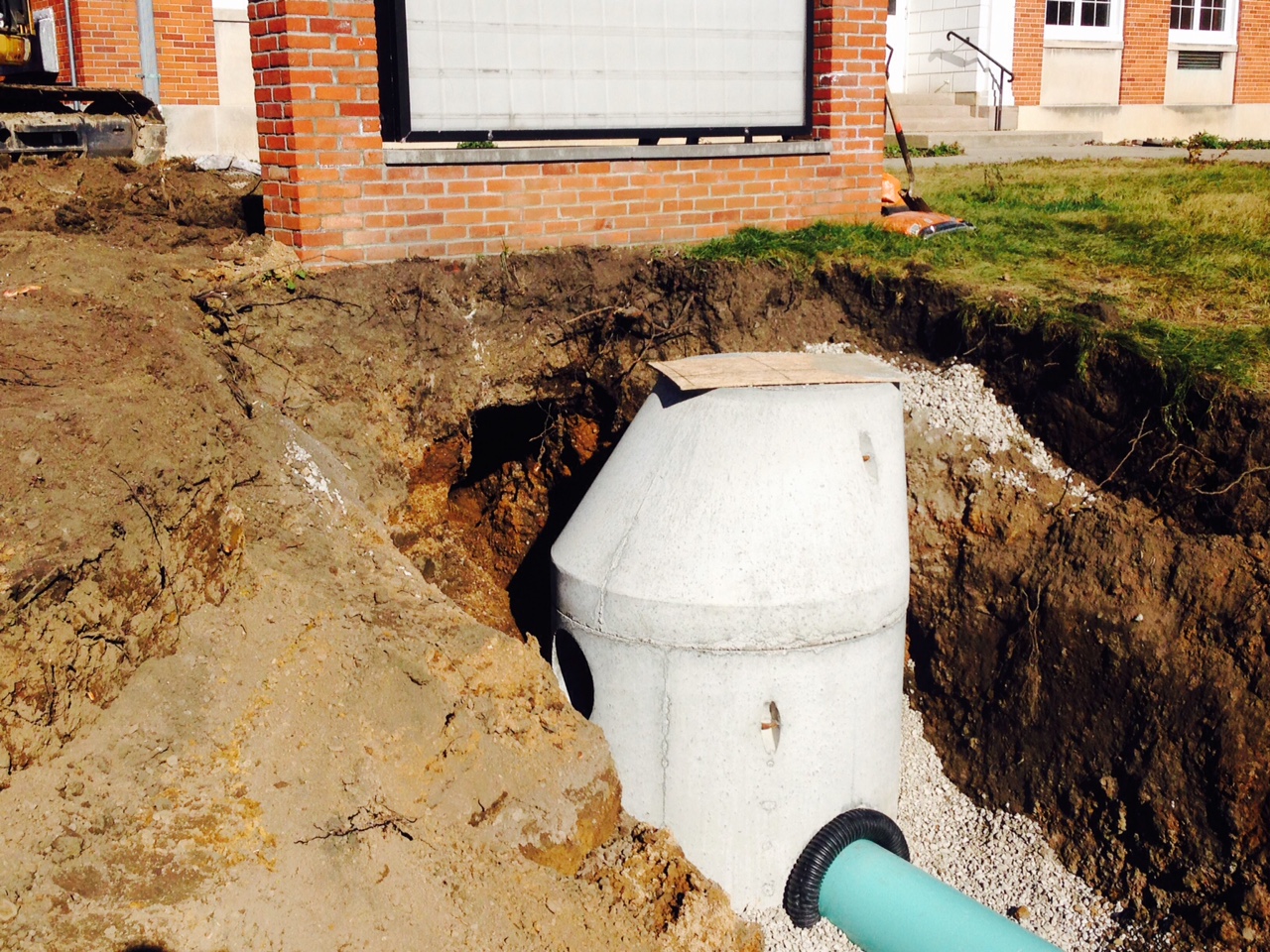
     In the early days of planning, we sort of ignored the underground storm water and sanitary sewer lines.   I guess we thought we would just tie into the Old School's existing line.  Let's see:  twenty-nine new apartments with showers and dishwashers and washing machines dumping waste water into an eighty-year old 8" clay tile.   What could possibly go wrong?  On top of that, it was sort of a mystery where the rain water from the gutters and downspouts was going.   The downspouts disappeared below grade and we weren't exactly sure where the water went from there.   Into the sanitary sewer system?  Into the ground?  It was hard to tell.  A preliminary conversation with the City Engineer about tying the new downspouts directly into the sanitary sewer system was met with a funny look.  (A bit of a back story:   The older sections of Newark are served by a combination sanitary and storm sewer.  EPA frowns on such things today, for good reason.  The City is actually in the middle of a massive, and very expensive, project separating the storm water system from the sanitary sewer system.  That separation is not scheduled anytime soon in the Old School's neighborhood. Also, West Main between 5th and 6th, which is the longest block in the downtown and is where the Old School resides, is not served by any storm water inlets.   For the most part, heavy rains caused the sidewalk in front of the Old School to flood.)  Anyway, back to the story.  Once we started work, we got a bit wiser.  Engineers were consulted and plans drawn to both install all new sanitary sewer lines from the building to the existing manhole in the middle of West Main, as well as new storm water lines, connecting the existing gutters and downspouts to a brand new catch basin that was installed along our front curb.  While not accounted for in the preliminary budget, this was an expense best not avoided.


New connection for one of the gutters


ditto

new storm and sanitary collection lines side by side

one more downspout connection

New manhole for all of the storm lines to connect into

Large pipe is the storm line from the manhole to the catch basin at the curb.
From there it flows to the combination sewer manhole in the center of West
Main.   When the City separates the sanitary from the storm in the future,
we will be prepared.


Smaller pipe is a sanitary sewer connection.  Larger pipe
is for storm water.

The plumber's job was to get the sanitary sewer line 3' out of the building.
From there, our excavator made the connections for the waste water to get
to the City sewer line in the middle of West Main Street.   This is the first step.


Making one more of the sanitary sewer connections

We also needed to put a sprinkler fire suppression system in
the building.   We would have done it anyway, but the
building code requires sprinklers for buildings over 14,000
square feet, especially when there is a "change of use."
This is the trench for the new 4" water line that will service
the Old School.


Oops.  What's this?    Right about here is where the new 4" water line is
supposed to enter the building.   We found what looked like a concrete vault
at the entry point.   No one knew why it was there, or what it was for. 
After much debate, we just drilled a hole through it and there was no problem


digging up West Main to make all the connections

playing in the mud

Safety first when working deep

Saturday, January 6, 2018

Yields................................


     Standing their before fifteen-thousand-strong crowd, Kennedy admitted to having once been a cheerleader for the country's commitment in Vietnam.  "But past error is no excuse for its own perpetuation.  All men make mistakes, but a good  man yields when he know his course is wrong and repairs the evil."

-Chris Matthews,  Bobby Kennedy:  A Raging Spirit