Tuesday, July 19, 2022

Character matters..........................

 If we are honest with ourselves, we must admit that there is some truth to the concept of fate.  We are prone to repeat the same decisions and methods of dealing with problems.  There is a pattern to our life, particularly visible in our mistakes and failures.  But there is a different way of looking at this concept: it is not spirits or gods that control us but rather our own character.  The etymology of the word character, from the ancient Greek, refers to an engraving or stamping instrument.  Character, then, is something that is so deeply ingrained or stamped within us that it compels us to act in certain ways, beyond our awareness and control.

-Robert Green, The Laws of Human Nature

Fifty years ago............................


On the television: Rowan & Martin's Laugh-In


In praise of economic growth..........

 The key to ending racial antagonism, then, doesn’t lie in equity programmes, but in economic growth and opportunity. Unity can’t just be conjured out of thin air — people need to feel it in their bank accounts first. This won’t be achieved through a national campaign of penance, or through boxing the country into a racial zero-sum game. If Biden really cares about America’s minorities, the goal should be simple: to help them to find a road to prosperity and financial independence, along with the rest of the country.

-Joel Kotkin, from this essay

It was actually good advice........................

I was given what I assume was bad-faith guidance, “Go and discover the new America."

(Spoiler alert)

I am more optimistic now than I was reading the news from afar – America is as it always was; righting wrongs, fighting for those who can’t fight for themselves, solving problems big and small that crop up in our daily lives through hard work and self-determination. I’m more optimistic than I have been in a while . . .

-Joel D. Hirst, from this post

Monday, July 18, 2022

Answers....................................

 ............................to big questions.

Reading this article on the James Webb telescope took me way back in time when the news was news with no embellishment, slant, or agenda other than informing.  I found it very refreshing and recommend it to you.


A few interesting snippets:

By comparison, it takes light about 1 second to travel from the moon and 8 minutes from the sun. Therefore, we see the sun as it was 8 minutes ago. If it were to disappear, we would find out 8 minutes later.

Webb also doesn't orbit Earth, like its predecessor Hubble does, but rather orbits the sun 1 million miles (1.5 million km) from our planet at what is called the second Lagrange point or L2. 

The Earth is not visible in any of the images. That is because the bottom of the James Webb Space Telescope, which is a tennis court sized shield, is always facing the sun to block it out.   It means that the Earth is always between James Webb and the sun as well, so would never be captured by the telescope.

When a telescope looks further away, it is also looking back in time. It takes time for the light the telescope is receiving to travel through space. Therefore, we see objects not as they are now but as they were at the time when they released the light that has travelled for billions of years across the universe to reach us.

What we are seeing is just a minor glimpse of images, science, knowledge yet to come.

his clarion call.............

 Pundits immediately lauded President Biden's brilliant plan, with MSNBC heralding it as the most transformative economic initiative since the New Deal. "Biden simply asking the economy to be better is nothing short of genius," said Rachel Maddow. "Economists are out there playing checkers, and Joe Biden is here playing chess, what with his clarion call to give everyone more money and make everything cheaper. Why has no one thought of this before?"

-The Babylon Bee has the full story


Work hard and read Hoffer.................

 Hoffer’s strongest words were for the intellectuals — or rather, against the intellectuals. “Intellectuals,” he said, “cannot operate at room temperature.” Hype, moral melodrama, and sweeping visions were the way that intellectuals approached the problems of the world.

But that was not the way progress was usually achieved in America. “Nothing so offends the doctrinaire intellectual as our ability to achieve the momentous in a matter-of-fact way, unblessed by words.”

Since the American economy and society advanced with little or no role for the intelligentsia, it is hardly surprising that anti-Americanism flourishes among intellectuals. “Nowhere at present is there such a measureless loathing of their country by educated people as in America,” Eric Hoffer said.”

Hoffer’s insights on the hubris of professional intellectuals is as profound as his reading of mass movements. Actually, the two are connected. “Mass movements do not usually rise until the prevailing order has been discredited. The discrediting is not an automatic result of the blunders and abuses of those in power, but the deliberate work of men of words with a grievance.”

-Thomas Sowell, writing about Eric Hoffer and culled from this essay

Checking in...........................


.........................with Eric Hoffer:

The hardest arithmetic to master is that which enables us to count our blessings

When hopes and dreams are loose in the streets, it is well for the timid to lock doors, shutter windows and lie low until the wrath has passed. For there is often a monstrous incongruity between the hopes, however noble and tender, and the action which follows them. It is as if ivied maidens and garlanded youths were to herald the four horsemen of the apocalypse.

There is not an idea that cannot be expressed in 200 words. But the writer must know precisely what he wants to say. If you have nothing to say and want badly to say it, then all the words in all the dictionaries will not suffice.

It is doubtful if the oppressed ever fight for freedom. They fight for pride and power — power to oppress others. The oppressed want above all to imitate their oppressors; they want to retaliate.

For though ours is a godless age, it is the very opposite of irreligious. The true believer is everywhere on the march, and both by converting and antagonizing he is shaping the world in his own image. And whether we are to line up with him or against him, it is well that we should know all we can concerning his nature and potentialities.

A man is likely to mind his own business when it is worth minding. When it is not, he takes his mind off his own meaningless affairs by minding other people's business.

Unless a man has talents to make something of himself, freedom is an irksome burden. Of what avail is freedom to choose if the self be ineffectual? We join a mass movement to escape individual responsibility, or, in the words of the ardent young Nazi, "to be free from freedom." It was not sheer hypocrisy when the rank-and-file Nazis declared themselves not guilty of all the enormities they had committed. They considered themselves cheated and maligned when made to shoulder responsibility for obeying orders. Had they not joined the Nazi movement in order to be free from responsibility?

Passionate hatred can give meaning and purpose to an empty life. Thus people haunted by the purposelessness of their lives try to find a new content not only by dedicating themselves to a holy cause but also by nursing a fanatical grievance. A mass movement offers them unlimited opportunities for both.

Both the revolutionary and the creative individual are perpetual juveniles. The revolutionary does not grow up because he cannot grow, while the creative individual cannot grow up because he keeps growing.

Our greatest weariness comes from work not done.

My young sons.........................

 ..................are believers in bitcoin.  Part of me wishes them well, part of me distrusts the whole thing, most of me knows nothing about it (and has little interest in learning about it).  My young sons are trying to nudge me along, to get with the latest and greatest.  And so, they gifted me this book this weekend—and asked me to actually read it.  Well, we will see.


In essence, bitcoin offered a payment network with its own native currency, and used a sophisticated method for members to verify all transactions without having to trust in any single member of the network.  The currency was issued at a predetermined rate to reward the members who spent their processing power on verifying the transactions, thus providing a reward for their work.  The startling thing about this invention was that, contrary to many other attempts as setting up a digital cash, it actually worked. . . .

     But in October 2009, an Internet exchange sold 5,050 bitcoins for $5.02, at a price of $1 for 1,006 bitcoins, to register the first purchase of bitcoin with money.  The price was calculated by measuring the value of electricity needed to produce a bitcoin. . . .

     Bitcoin can be best understood as distributed software that allows for transfer of value using a currency protected from unexpected inflation without relying on trusted third parties.

-as excerpted from the Prologue

Present........................

 There is no past and no future; no one has ever entered those two imaginary kingdoms.  There is only the present.  Do not worry about the future, because there is no future.  Live in the present and for the present, and if your present is good, then it is good forever.

-LeoTolstoy

Fifty years ago.....................................


Blue Oyster Cult....Cities On Flame with Rock and Roll

On character and power......................

 So often we think that power has changed people, when in fact if simply reveals more of who they are. . . . Remember, weak character will neutralize all of the other possible good qualities a person might possess.

-Robert Greene, The Laws of Human Nature

a miracle.........................


      Everything is miraculous.  It is a miracle that one does not melt in one's bath.

-attributed to Pablo Picasso

Pablo Picasso    Personnage      Oil on canvass    1927  


Opening paragraphs.............................

      When a high-powered rifle bullet hits living flesh it makes a distinctive—pow-WHOP—sound that is unmistakable even at tremendous distance.  There is rarely an echo or fading reverberation or the tailing rumbling hum that is the sound of a miss.  The guttural boom rolls over the terrain but stops sharply in a close-ended way, as if jerked back.  A hit is blunt and solid like an airborne grunt.  When the sound is heard and identified, it isn't easily forgotten.

-C. J. Box, as he opens Open Season, the first of many in his truly wonderful Joe Pickett series

Sunday, July 17, 2022

On power..........................

Why has there been so much misunderstanding around that day in the Valley of Elah?  On one level, the duel reveals the folly of our assumptions about power.  The reason King Saul is skeptical about David's chances is that David is small and Goliath is large.  Saul thinks of power in terms of physical might.  He doesn't appreciate that power can come in other forms as well—in breaking rules, in substituting speed and surprise for strength.  Saul is not alone in making that mistake. . . .

      What the Israelites saw, from high on the ridge, was an intimidating giant.  In reality, the very thing that gave the giant his size was also the source of his greatest weakness.  There is an important lesson in that for battles with all kinds of giants.  The powerful and strong are not always what they seem.

-Malcolm Gladwell, David and Goliath: Underdogs, Misfits, and the Art of Battling Giants

that makes sense....................

 A Kiowa child's learning "is begun only after becoming aware of the mystery of all that is around him, strictly from a feeling point of view", says Kiowa spokesperson Allen Quetone.  This is common to all children: to learn feelingly, the mind and body walking hand in hand.  We say "it makes sense," meaning that a thought is coherent, as language itself remembers that mind is inheld in the body, skeined into an intricate kinship with the body which is itself catscradled in nature.  Thoughts are interlinked in feeling.  For feeling is not only a sense of touch but a form of knowing, the psyche dispersed, sensitive in skin, muscle and gut, perceiving the messages of a speaking world: the mind sensitive as the strings of a harp struck softly by an unlying wind, an Aeolian harp with a quality of ceaseless potential music sung into sound with breath, the lightest inspiration of a million, million messages.

-Jay Griffiths, A Country Called Childhood: Children and the Exuberant World

Newell Convers Wyeth.............................


more here

the shadowed wonder and wildness.........

       The hyper-rational objectivity behind a great deal of contemporary techno-science could only have arisen in a civilization steeped in a dogmatic and other-worldly monotheism, for it is largely a continuation of the very same detached and derogatory relation to sensuous nature.  If in an earlier era we spoke of the earthly world as fallen, sinful, and demonic, we now speak of it as mostly inert, mechanical, and determinate.  In both instances nature is stripped of its generosity and prodigious creativity.  Similarly, the utopian technological dreaming that would have us bioengineer our way into a new and "more perfected" nature (or would have us download human consciousness into a "better hardware"), like the new-age wish to spiritually transcend the "physical plane" entirely, seems calculated to help us hide from the shadowed wonder and wildness of earthly existence.

-David Abram, Becoming Animal: An Earthly Cosmology

rejection........................

 As an extension of our positivity/consumer culture, many of us have been "indoctrinated" with the belief that we should try to be as inherently accepting and affirmative as possible.  This is a cornerstone of many of the so-called positive thinking books: open yourself up to opportunities, be accepting, say yes to everything and everyone, and so on.

     But we need to reject something.  Otherwise, we stand for nothing.  If nothing is better or more desirable than anything else, then, we are empty and our live is meaningless.  We are without values and therefore live our life without any purpose. . . .

     The act of choosing a value for yourself requires rejecting alternative values.  If I choose to make my marriage the most important part of my life, that means I'm (probably) choosing not to make cocaine-fueled hooker orgies an important part of my life.  If I'm choosing to judge myself based on my ability to have open and accepting friendships, that means I'm rejecting trashing my friends behind their backs.  These are healthy decisions, yet they require rejection at every turn.

      The point is this: we all must give a fuck about something, in order to value something.  And to value something, we must reject what is not that something.  To value X, we must reject non-X.

      That rejection is an inherent and necessary part of maintaining our values, and therefore our identity.  We are defined by what we choose to reject.

-Mark Manson, The Subtle Art Of Not Giving A F*uck: A Counterintuitive Approach To Living A Good Life

projection........................

 If you approach a negotiation thinking that the other guy thinks like you, you're wrong, I say.  That's not empathy; that's projection.

-Chris Voss

On fairness...................

 The most powerful word in negotiations if "Fair."  As human beings, we're mightily swayed by how much we feel we have been respected.  People comply with agreements if they feel they've been treated fairly and lash out if they don't.

-Chris Voss, Never Split the Difference: Negotiating As If Your Life Depended On It

This explains a lot.................

 Going to war accelerated the move from indirect to direct rule.  Almost any nation that makes war finds that it cannot pay for the effort from its accumulated reserves and current revenues.  Almost all warmaking states borrow extensively, raise taxes, and seize the means of combat—including men—from reluctant citizens who have other uses for their resources.

-Charles Tilly

unlikely...........................

     The GM sit-down strike of 1936-37 and the other forcible plant seizures of the time were examples of a phenomenon we described in Blood in the Streets as "the exploitation of the capitalists by the workers."  This was not the view that Pete Seeger set to music in his sad songs.  But unless you a planning a career as a folk singer in a blue-collar neighborhood the important thing is to focus on is not the popular interpretation, but the underlying reality.  Wherever you look in history there is generally a layer of rationalization and make-believe that disguises the true megapolitical foundations of any systematic extortion.  If you take the rationalizations at face value, you are unlikely to grasp what is really going on.

-James Dale Davidson and Lord William Rees-Mogg, The Sovereign Individual: Mastering The Transition To The Information Age


Pete Seeger.........................Which Side Are You On?


Which side are you on, boys?
Which side are you on?
Which side are you on, boys?
Which side are you on?
They say in Harlan County
There are no neutrals there
You'll either be a union man
Or a thug for J. H. Blair
Which side are you on, boys?
Which side are you on?
Tell me, which side are you on, boys?
Which side are you on?
My daddy was a miner
And I'm a miner's son
He'll be with you fellow workers
Until this battle's won
Tell me, which side are you on?
Which side are you on?
Sing it, which side are you on?
Which side are you on?
Oh workers can you stand it?
Tell me how you can
Will you be a lousy scab
Or will you be a man?
Which side are you on?
Tell me, which side are you on?
Which side are you on?
Come all of you good workers
Good news to you I'll tell
Of how the good ol' union
Has come in here to dwell
Tell me, which side are you on, boys?
Which side are you on?
Tell me, which side are you on, boys?
Which side are you on?

Fifty years ago...........................


.................................at the newsstand:  


Saturday, July 16, 2022

True about most things....................


You...........................


According to......................

 ...........the blogspot counting thing, the 20,000-post threshold has been crossed.   My apologies for all the litter on the Intertunnel floor.  Hopefully some value has been extracted.

The Peshtigo Principle...................

 When you think you’ve got all the facts, look a little more.

When you think you’ve got a good solution to a problem, push on to see if there’s a better one.

When you think you’ve done your due diligence, take a deep breath and make one more call.

The important fact you need could be out there, just out of sight.

-Wally Bock

thanks Michael

In the background...............................


Bob James...........................................Joy Ride


Checking in...........................

 ...........................with Bertrand Russell:

He could not, in any case, have succeeded in politics, because of his very exceptional intellectual integrity; he was always willing to admit the weak points on his own side and the strong points on that of his opponents.   (Russell talking about his father)

 She had that indifference to money which is only possible to those who have always had enough of it.   (Russell talking about his grandmother)

My grandfather’s library, which became my schoolroom, stimulated me in a different way. There were books of history, some of them very old; I remember in particular a sixteenth-century Guicciardini. There were three huge folio volumes called L’Art de vérifier les dates. They were too heavy for me to move, and I speculated as to their contents; I imagined something like the tables for finding Easter in the Prayer Book. At last I became old enough to lift one of the volumes out of the shelf, and I found, to my disgust, that the only ‘art’ involved was that of looking up the date in the book. Then there were The Annals of Ireland by the Four Masters, in which I read about the men who went to Ireland before the Flood and were drowned in it; I wondered how the Four Masters knew about them, and read no further. There were also more ordinary books, such as Machiavelli and Gibbon and Swift, and a book in four my mental development 11 volumes that I never opened: The Works of Andrew Marvell Esq. M.P. It was not till I grew up that I discovered Marvell was a poet rather than a politician. I was not supposed to read any of these books; otherwise I should probably not have read any of them.

William Lord Russell, who was executed under Charles II, was held up for special admiration, and the inference was encouraged that rebellion is often praiseworthy.

In 1895, when in Berlin, I made a study of German Social Democracy, which I liked as being opposed to the Kaiser, and disliked as (at that time) embodying Marxist orthodoxy. For a time, under the influence of Sidney Webb, I became an imperialist, and even supported the Boer War. This point of view, however, I abandoned completely in 1901; from that time onwards, I felt an intense dislike of the use of force in human relations, though I always admitted that it is sometimes necessary.

 But China did one thing for me that the East is apt to do for Europeans who study it with sensitive sympathy: it taught me to think in long stretches of time, and not to be reduced to despair by the badness of the present.

The question of discipline in childhood, like all other practical questions, is one of degree.

History has always interested me more than anything else except philosophy and mathematics. I have never been able to accept any general schema of historical development, such as that of Hegel or that of Marx. Nevertheless, general trends can be studied, and the study is profitable in relation to the present.

The relation of philosophy to social conditions has usually been ignored by professional philosophers. Marxists are interested in philosophy as an effect, but do not recognize it as a cause. Yet plainly every important philosophy is both. 

. I have always ardently desired to find some justification for the emotions inspired by certain things that seemed to stand outside human life and to deserve feelings of awe. I am thinking in part of very obvious things, such as the starry heavens and a stormy sea on a rocky coast; in part of the vastness of the scientific universe, both in space and time, as compared to the life of mankind; in part of the edifice of impersonal truth, especially truth which, like that of mathematics, does not merely describe the world that happens to exist.

-All excerpts from his essay, "My Mental Development"

Did I mention............................


 .........that I am now a grandfather?


Almost like he thinks he owns the place......


Way out........................

 Of all 36 ways to get out of trouble, the best way is — leave.

-maybe a Chinese proverb

central problem......................

 Protection of life and property is indeed a crucial need that has bedeviled every society that has ever existed.  How to fend off violent aggression is history's central problem.  It cannot easily be solved . . .

-James Dale Davidson and Lord William Rees-Mogg, The Sovereign Individual: Mastering The Transition To The Information Age

Seat belts fastened.................................

 Today most people believe that cultures are more matters of taste than sources of guidance for behavior that can mislead as well as inform.  We are all too keen to believe that all cultures are created equal, too slow to recognize the drawbacks of counterproductive cultures.  This is especially true of the hybrid cultures that have begun to emerge in the hothouse of subsidy and intervention in many parts of the world in this century.  Like the criminal subculture of America's inner cities, they retain incoherent bits of pieces of cultures appropriate to earlier stages of economic development and combine them with values for informing behavior in the Information Age.

       The Information Revolution, therefore, will not merely release the spirit of genius, it will also unleash the spirit of nemesis.  Both will contest as never before in the millennium to come.

       The shift from an Industrial to an Information Society is bound to be breathtaking.  The transition from one stage of economic life to another has always involved a revolution.  We think that the Information Revolution is likely to be the most far-reaching of all.  It will reorganize life more thoroughly than either the Agricultural Revolution or the Industrial Revolution.  And its impact will be felt in a fraction of the time.  Fasten your seat belts.

-James Dale Davidson and Lord William Rees-Mogg, The Sovereign Individual: Mastering The Transition To The Information Age

Wednesday, July 13, 2022

The hopeful birth..........................

 .........................of a sub-division:

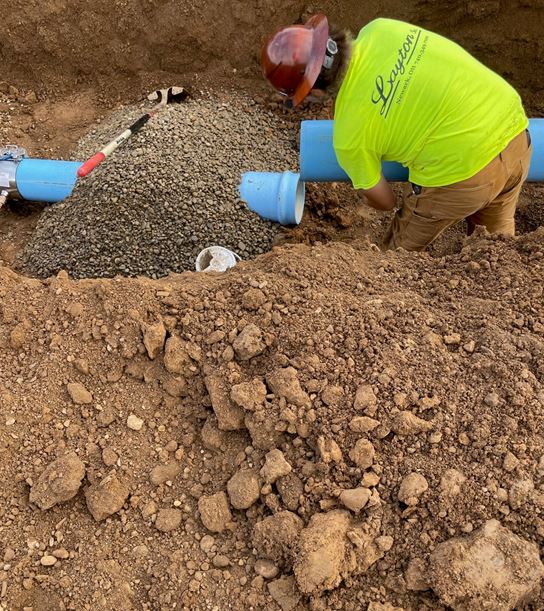
       Episode 25:  Phase Two water line installation.

The blue pipe is the water main.  All that pipe will be in the
ground today, we hope.


One pipe at a time

Making a solid, leak-proof connection between pipes

Beginning the tap for the service lateral


Unrolling the 3/4" copper water service line

setting the shut-off valve

One water lateral installed.  Next......


Meanwhile, back in Phase One:

Phase One from a distance.  Houses sprouting everywhere

All this since February

Your basic new house.  Awaiting the drywallers

"Sold".  My favorite sign


Sunday, July 10, 2022

demand...........................

 War has long been a rite of passage, with new generations feeling a need to prove their courage and earn the right to supplant their elders.  Clay's generation grew up on the hero tales of the American Revolution—the stories of boldness in the political arena and valor on the battlefield.  Often implicit in the stories, as in the stories of every generation of elders, was skepticism that the younger generation had what it took to match the elders' feats.  Where was the George Washington of the younger set, the general who could smite the British as Washington had done at Yorktown?  Where were the Patrick Henry and Thomas Jefferson, whose words inspired a nation and brought down an empire?  Where were the James Madison and Alexander Hamilton, the framers of a new government for a new nation?

     Henry Clay had heard the stories and felt the skepticism.  He was burdened with no conspicuous personal sense of inferiority, but he reckoned that an ambitious young politician could do worse than demand that the country complete the work commenced by the generation of the founders.

-H. W. Brands,  Heirs of the Founders:  The Epic Rivalry of Henry Clay, John Calhoun and Daniel Webster

A paean to..................


........................................ Booker T. Jones.


concentrated, coherent, and connected.....

 It is almost a physical law: What is bloated beyond its proportions inevitably collapses. The mind must not wander from goal to goal, or be distracted by success from its sense of purpose and proportion. What is concentrated, coherent, and connected to its past has power. What is dissipated, divided, and distended rots and falls to the ground. The bigger it bloats, the harder it falls.

-Robert Greene, 48 Laws of Power

Mania..............................

      All the major troubles we have had in the last half century have been caused by people who have let politics become a mania.

-Robert Conquest, The Dragons of Expectation: Reality and Delusion in the Course of History

Parenting advice........................

 ...............................from Louis L'Amour:

     From earliest childhood she had been taught to accept responsibility, and to make her own decisions and abide by them.  "Every youngster wants to be grown-up," her father had said, "but the difference between a child and an adult is not years, but rather it's a willingness to accept responsibility, to be responsible for one's own actions.

-as culled from his book, Flint

Tuesday, July 5, 2022

Fifty years ago..........................


Argent..................................Hold Your Head Up

a resurgent romantic revolution....

      Childhood itself is the quintessential Romanticism, and every child needs to be allowed to live in that state of grace, but wider society also needs the romance of childhood for its very creativity, requiring the reckless rapture of the puer* figure, the eternal child within culture, whose incandescence must be tended and attended to, so that its light can flare in the storyteller or dancer, so that the risk-taking, anarchic and flame-like quality, the eternal return of the great romance of childhood which exists within us all, can flame in a resurgent romantic revolution.  The chill of our utilitarian age needs that fire.

-Jay Griffiths, A Country Called Childhood

*in case you are wondering about the choice of this word, go here.

simple..................

       But allow me to let you in on a secret:  Life is negotiation.

      The majority of the interactions we have at work and at home are negotiations that boil down to the expression of a simple, animalistic urge:  I want.

-Chris Voss, Never Split the Difference: Negotiating As If Your Life Depended On It

Checking in..................................

 .........................with Dan Sullivan:

The only way to make your present better is by making your future bigger.

Personal confidence comes from making progress toward goals that are far bigger than your present capabilities.

Your eyes only see and your ears only hear what your brain is looking at

. . .first to sell yourself on the vision, because you can't sell other people unless you're sold yourself.

If you have enough money to solve a problem, then you don't have a problem.

All progress starts by telling the truth.

Always make your learning greater than your experience.

Who do you want to be a hero to?

Monday, July 4, 2022

The lazy way.................

.........................to an awesome life:

 As Eric Hoffer once said, “When people are free to do as they please, they usually imitate each other.” Sometimes it’s quite deliberate but more often it’s unconscious. We’re just wired for it. This is what it means when we say humans are a social species. . . .

Peer pressure isn’t good or bad – your peers are. If you moved your troubled teen to a new high school filled with well-behaved students, would you be hoping your child was immune to peer pressure — or very susceptible? . . .

We’re never utterly autonomous. We’re social creatures. Why not leverage our fundamental nature rather than (often futilely) resisting it? Sometimes we’re weak on our own but groups are strong. We need others to help us do the right thing, even with individual goals. The logical conclusion is to be a part of a group where your desired reputation aligns with who you want to be as a person.

-Eric Barker

Fifty years ago.............................


Don McLean...................................American Pie

On philosophers................

 PHILOSOPHY being nothing else but the study of Wisdom and Truth, it may with reason be expected, that those who have spent most Time and Pains in it should enjoy a greater calm and serenity of Mind, a greater clearness and evidence of Knowledge, and be less disturbed with Doubts and Difficulties than other Men. Yet so it is we see the Illiterate Bulk of Mankind that walk the High-ro.ad of plain, common Sense, and are governed by the Dictates of Nature, for the most part easy and undisturbed. To them nothing that's familiar appears unaccountable or difficult to comprehend. They complain not of any want of Evidence in their Senses, and are out of all danger of becoming Sceptics. But no sooner do we depart from Sense and Instinct to follow the Light of a Superior Principle, to reason, meditate, and reflect on the Nature of Things, but a thousand Scruples spring up in our Minds, concerning those Things which before we seemed fully to comprehend. Prejudices and Errors of Sense do from all Parts discover themselves to our view; and endeavouring to correct these by Reason we are insensibly drawn into uncouth Paradoxes, Difficulties, and Inconsistencies, which multiply and grow upon us as we advance in Speculation; till at length, having wander'd through many intricate Mazes, we find our selves just where we were, or, which is worse, sit down in a forlorn Scepticism.

-George Berkeley

Happy 4th of July..............


Sunday, July 3, 2022

Already has...........................


Enjoying the weekend...................


via

Yep................................

............... Growing up, this was the best form of self-help.  Miss those days.

Maximize........................

      For thousands of years, the primary goal of any ruler was to maximize his own wealth.  The divine right of kings yielded only under the greatest of duress, as occurred at Runnymede in 1215.  Premodern Europe was a maelstrom of constant warfare among small states—"nation" is too good a word to describe all but the largest.  Estimates vary, but in the medieval period, as many as a thousand sovereign principalities were scattered across the continent.  The clever prince or duke learned that if he taxed laborers and merchants too heavily, they were liable to take their business a few miles up the road, where levies lay lighter on the purse.

     Slowly, rulers began to identify their own well-being with that of their subjects and learned not to pluck too many feathers from the goose.  States that neither taxed their subjects too heavily nor seized their property too often found themselves with fuller treasuries and larger armies than states that did.  Nations that could not refrain from plundering their own subjects grew weaker, and, in many cases, disappeared.  Gradually, through this Darwinian process, states with enlightened taxation, rule of law, and secure property rights prospered and prevailed over their less advanced neighbors, and Europe became a good place to get rich.

-William J. Bernstein, The Birth of Plenty: How The Prosperity of the Modern World Was Created

Part of the fabric...............

       Acquisitiveness is a universal phenomenon, among animals as well as human beings, children as well as adults, primitive peoples as well as those culturally advanced.  It is rooted in the instinct of self-preservation, but it also has an important psychological dimension in that it enhances feelings of self-assurance and competence.  Its objects are, in the first place, material goods, but it also has an incorporeal aspect, embracing ideas, artistic creations, inventions, and even the very space that surrounds us.  Claims to exclusive use are especially emphatic in respect to land with which humans are linked by mystic bonds.  The notion of primitive communism has not basis in fact: it is simply the ancient—and, apparently, indestructible—myth of the Golden Age dressed up in modern pseudo-scientific language.  Anthropology has not knowledge of societies ignorant of property rights: in the words of E. A. Hoebel cited above, "property is as ubiquitous as man, a part of the basic fabric of all society."  Which means, to employ Aristotelian terminology, that it is not merely a "legal" or "conventional" but a "natural" institution.  As such it is no more a subject of moralizing (unless it be for its excesses) than mortality or any other aspect of existence over which humans have at best minimal control.

-Richard Pipes, Property and Freedom

Fifty years ago.......................


Climax........................................Precious and Few

Words matter.................

      "The task of a philosopher: we should bring our will into harmony with whatever happens, so that nothing happens against our will and nothing that we wish for fails to happen."

-Epictetus, Discourses, 2.14.7

    A long To-Do list seems intimidating and burdensome—all these things we have to do in the course of a day or week.  But a Get-To-Do list sounds like a privilege—all the things we're excited about the opportunity to experience.  This isn't just semantic playing.  It is a central facet of the philosopher's world view.

-Ryan Holiday, excerpted from today's entry in The Daily Stoic

paralyzed...................

      Philosophy, throughout its history, has consisted of two parts inharmoniously blended: on the one hand a theory as to the nature of the world, on the other an ethical or political doctrine as to the best way of living.  The failure to separate these two with sufficient clarity has been a source of much confused thinking.  Philosophers, from Plato to William James, have allowed their opinions as to the constitution of the universe to be influenced by the desire of edification: knowing, as they supposed, what beliefs would make men virtuous, they have invented arguments, often very sophistical, to prove that these beliefs are true.  For my part I reprobate this kind of bias, both on moral and on intellectual grounds.  Morally, a philosopher who uses his professional competence for anything except a disinterested search for truth is guilty of a kind of treachery.  And when he assumes, in advance of inquiry, that certain beliefs, whether true or false, are such as to promote good behaviour, he is so limiting the scope of philosophical speculation as to make philosophy trivial; the true philosopher is prepared to examine all preconceptions.  When any limits are placed, consciously or unconsciously, upon the pursuit of truth, philosophy becomes paralyzed by fear, and the ground is prepared for a government censorship punishing those who utter 'dangerous thoughts'—in fact, the philosopher has already placed such a censorship over his own investigations.

-Bertrand Russell,  as culled from his essay The Philosophy of Logical Analysis (1946)

Property...................

Without an integrated formal property system, a modern market economy is inconceivable. Had the advanced nations of the West not integrated all representations into one standardized property system and made it accessible to all, they could not have specialized and divided labor to create the expanded market network and capital that have produced their present wealth. The inefficiencies of non-Western markets have a lot to do with the fragmentation of their property arrangements and the unavailability of standard representations.

-------

Formal property’s contribution to mankind is not the protection of ownership; squatters, housing organizations, mafias, and even primitive tribes manage to protect their assets quite efficiently. Property’s real breakthrough is that it radically improved the flow of communications about assets and their potential.

-Hernando De Soto, The Mystery of Capital:  Why Capitalism Triumphs In The West And Fails Everywhere Else